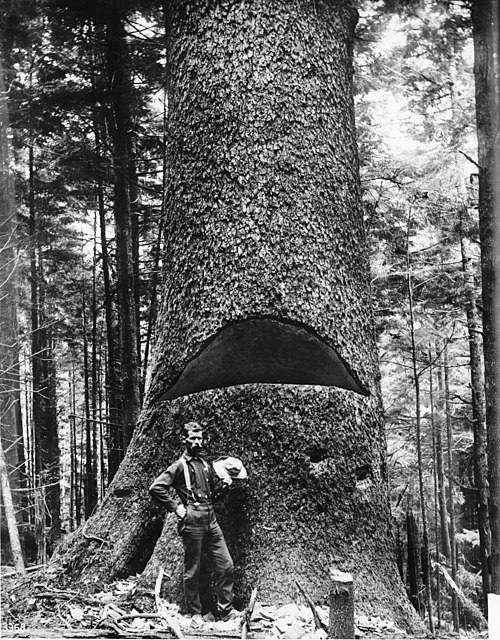
A tree falls in a forest, and whether it makes any noise or not, it’s just a dead tree. The lumberman who cuts it into lumber makes the tree something it was not. The man turns the dead tree into a product. A shepherd who shears his sheep and gathers the fleece. A woman knits yarn to make a sweater. All of them transform something originally worthless into something of value.
The United States economy, our “gross domestic product,” is composed mainly of “service sector” activities. Eight out of ten of us are employed in this sector. Until recently the greater source of wealth in our country was manufacturing. We were lumbermen, shepherds and knitters. “Free trade” policies in the late twentieth century allowed Americans to purchase less expensive imported televisions, cars, clothing and furniture. Countries with cheaper labor learned to produce things, transforming raw materials into consumer goods, creating value. Americans were delighted with this, oblivious to the reality that the creation of value was disappearing. We became a nation of service sector consumers. To complete this Frankenstein scenario, in a frantic effort to kill the monster it created, our government is now brandishing trade tariffs.
Is this too little too late, or something worse? Are we not, instead of killing the monster, punishing ourselves by increasing the prices of everything? Do we think we can rebuild the factories and train the workforce to compete with emerging capitalism? Won’t discouraging immigration prevent our own competitiveness? Is our infrastructure, ambition and our knowhow sufficient to replace or even compete with the rest of the world? Making foreign furniture more expensive will not increase the value of our trees.
Doubtless in time we will understand that our destiny and even our existence depend on worldwide cooperation. There will always be producers and customers, always be manufacturers and servers, but in time we will not be separated by militarily enforced borders, arbitrary government policies and other symptoms of envy and hatred. In the enlightened future we will see that the creation of real value depends on transformation of a tree into a desk, and of citizens of a country into citizens of the earth.
 Nick Hilton - Reflections