Of Value and Tariffs

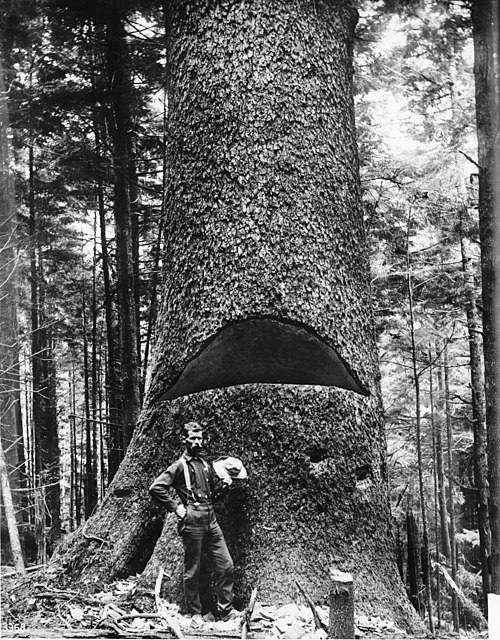
A tree falls in a forest, and whether it makes any noise or not, it’s just a dead tree. The lumberman who cuts it into lumber makes the tree something it was not. The man turns the dead tree into a product. A shepherd who shears his sheep and gathers the fleece. A woman knits yarn to make a sweater. All of them transform something originally worthless into something of value.

The United States economy, our “gross domestic product,” is composed mainly of “service sector” activities. Eight out of ten of us are employed in this sector. Until recently the greater source of wealth in our country was manufacturing. We were lumbermen, shepherds and knitters. “Free trade” policies in the late twentieth century allowed Americans to purchase less expensive imported televisions, cars, clothing and furniture. Countries with cheaper labor learned to produce things, transforming raw materials into consumer goods, creating value. Americans were delighted with this, oblivious to the reality that the creation of value was disappearing. We became a nation of service sector consumers. To complete this Frankenstein scenario, in a frantic effort to kill the monster it created, our government is now brandishing trade tariffs.

Is this too little too late, or something worse? Are we not, instead of killing the monster, punishing ourselves by increasing the prices of everything? Do we think we can rebuild the factories and train the workforce to compete with emerging capitalism? Won’t discouraging immigration prevent our own competitiveness? Is our infrastructure, ambition and our knowhow sufficient to replace or even compete with the rest of the world? Making foreign furniture more expensive will not increase the value of our trees.

Doubtless in time we will understand that our destiny and even our existence depend on worldwide cooperation. There will always be producers and customers, always be manufacturers and servers, but in time we will not be separated by militarily enforced borders, arbitrary government policies and other symptoms of envy and hatred. In the enlightened future we will see that the creation of real value depends on transformation of a tree into a desk, and of citizens of a country into citizens of the earth.

Nice Truck!

Almost every social or governmental issue these days is a boxing match, fighters charging out from opposite corners punching, swinging for a knockout. Look at economic policy for example. John Maynard Keynes’s ideas, advocating intervention when demand falters, using tax and investment to correct economic conditions, are favored by one side. These are considered “liberal.” Milton Friedman’s Chicago School proposes tactics associated with “conservative” attitudes: controlling interest rates to regulate the money supply, sanctioning free trade, allowing markets at every level to self-regulate. Friedman learned to box in Ayn Rand’s Atlas Shrugged gym; Keynes took lessons from Upton Sinclair’s The Jungle, a very different Chicago school.

Both of these approaches are functional and both are faulty. Over-regulation of the money supply may have unintended consequences and foreign governments may manipulate domestic policies to keep their exports competitive. Federal interventions, like welfare, don’t always work at the outer reaches of a good idea; good intentions don’t guarantee efficient results. Analysis of the complexities and the choice of the proper remedy should be left to wise, unbiased practitioners, not stage actors competing for votes.

Value is a consequence of desire. Desire is regulated by human emotions. An optimistic outlook promotes positive activity, purchasing, investment, confidence in the future. Economic downturn is the result of negative emotion, pessimism, fear. The “Great Depression” and economic downturns generally have been caused by a contagious fear that things are going to get worse and thus, inevitably, they do. The value of a new home or a new t-shirt increases and diminishes with my desire to own it, which varies with my confidence or insecurity. Would I rather live in a new house or have that money in the bank? These days the omnipresent media constantly presents the boxing match of policy making with no neutral voice, each side predicting doom if they lose. It is like having two plumbers under your kitchen sink cursing, arguing about which wrench to use. Which one can fix it?

Neither Friedman nor Keynes was 100% right. Not all remedies are guaranteed and orthodoxy does not guarantee success. The the principal responsibility of a leader is to inspire confidence, to combat negative emotions in words and actions. This is the problem with modern democracy: electing leaders based on their popularity instead of their background, education, demonstrated wisdom and proven ability is like hiring a plumber because you like his truck.